

Tel: 07748 987519
Systeme.io vs Thinkific: Which Is Better for Musicians Selling Online Courses?
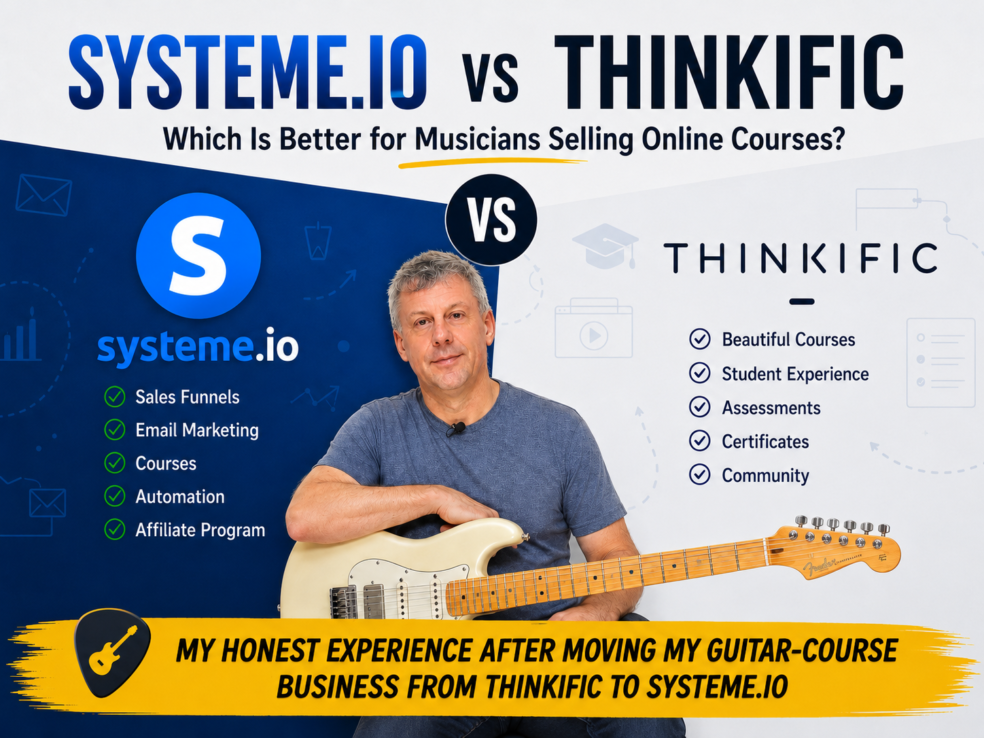
Systeme.io vs Thinkific: Which Is Better for Musicians Selling Online Courses?
My honest experience after moving my online guitar-course business from Thinkific to Systeme.ioAd/Affiliate disclosure: This article contains affiliate links. If you sign up or make a purchase through one of these links, I may receive a commission at no additional cost to you. I previously paid for and used Thinkific to host my guitar courses. I now use Systeme.io to run my course business, so this comparison is based on my own experience rather than a theoretical list of features.
Information and prices checked on 22 July 2026.
The short answer
Thinkific is an excellent dedicated online-course platform. If your main priority is creating a polished learning environment with sophisticated course-delivery features, Thinkific may still be the better choice.
However, I eventually realised that creating and hosting courses was not the biggest challenge in my business.
The real challenge was selling them.
I needed landing pages, sales funnels, email marketing, automated follow-up sequences, checkout pages, order bumps and upsells. I also needed all of those elements to work together without an increasingly expensive collection of separate subscriptions.
That is why I moved my guitar-course business from Thinkific to Systeme.io.
For my business, Systeme.io has proved to be the better choice—not because Thinkific was a bad platform, but because Systeme.io solved the problem I actually had.
My background as an online-course creator
I am a professional guitarist and guitar teacher in the UK. I teach around 60 to 70 students each week during school terms, both privately and in schools.
Over the years, I have also created several substantial guitar courses, including courses covering:
- Major scales and modes
- Chords and chord substitution
- Ear training
- Guitar technique
- A collection of 250 guitar licks
- My guitar theory and technique book
My long-term goal has always been to turn more of my knowledge into products that can help guitarists without requiring me to teach every lesson individually.
Like many musicians and teachers, however, I am very good at creating educational material and considerably less enthusiastic about constructing complicated marketing systems.
That distinction became important.
Why I originally chose Thinkific
Thinkific seemed like the obvious choice when I first started building online courses.
It is a specialist course platform. It looks professional, the course material is presented clearly, and it provides a structured environment in which students can work through lessons.
I built three major guitar courses on Thinkific and also used it as part of the online home for my book and other educational material.
As a teaching platform, it worked.
I want to make that clear because this is not an article claiming that Thinkific is terrible simply because I later moved elsewhere. Existing students could log in, watch the videos and work through the material. The platform did what it was designed to do.
Thinkific’s current paid plans include unlimited published courses, with features such as communities, digital downloads, coaching products, landing pages, email automation and learner reporting varying between plans.
The problem was not that Thinkific could not host my courses.
The problem was that hosting courses did not automatically result in people buying them.
A professional course platform is not the same as a sales system
For some time, my online-course sales were sporadic.
I had created a lot of valuable material, but I had not built a simple and repeatable route that took someone from:
“I have a problem with my guitar playing”
to:
“This course is the obvious next step for me.”
Thinkific was effectively the classroom. I still needed to bring students through the door.
My wider setup included websites, landing pages, ActiveCampaign for email marketing and various connections between them. Each individual component could do its job, but the complete system became complicated.
Whenever I wanted to launch a new product, I had to think about:
- Where the sales page would live
- How the customer would pay
- How access would be granted
- Which email sequence they would enter
- How different products would connect
- How to offer an additional course after checkout
- Whether all the integrations were working correctly
Instead of concentrating on making an attractive offer and putting it in front of more guitarists, I could easily spend hours thinking about software.
That is not a criticism of Thinkific alone. It is a problem that can arise whenever several specialised tools are joined together.
However, it made me question whether a dedicated course platform was still the right centre of my business.
The cost became difficult to justify
I was paying £754 per year for the Thinkific Start plan.
That might be perfectly reasonable for an established course business producing consistent monthly revenue. It was much harder to justify while my courses were only making occasional sales.
Thinkific has announced another pricing change taking effect from 13 August 2026. Its listed UK annual price for the Start plan is due to increase from £754 to £828, while monthly billing will rise from £84 to £92. Its Basic plan is due to rise from £367 to £408 annually, or from £42 to £46 when paid monthly.
The subscription was therefore becoming a major annual business expense before I had built a dependable system for selling the products hosted on it.
I did not merely need cheaper course hosting. I needed a different approach.
Why I chose Systeme.io
Systeme.io appealed to me because it approached the business from the opposite direction.
Rather than starting with the course and adding marketing tools around it, Systeme.io starts with the complete customer journey.
Its core tools include:
- Sales funnels
- Landing pages
- Email marketing
- Marketing automation
- Checkout pages
- Order bumps
- One-click upsells
- Online courses
- Blogs and websites
- Affiliate-program management
Systeme.io currently offers a free plan with up to 2,000 contacts, three sales funnels, one blog, one course, one custom domain and unlimited emails. The Startup plan is listed at $17 per month and increases the allowance to 5,000 contacts and five courses. Systeme.io says all plans include unlimited students, unlimited file storage and no additional platform transaction fee when accepting payments through supported payment providers.
That meant I could build the offer, sales page, checkout, email follow-up and course delivery within one connected system.
It was much closer to what I actually needed.
I did not simply copy everything across
Did the new funnel make sales?
Moving platforms gave me an opportunity to rethink the business rather than reproducing exactly the same structure somewhere cheaper.
My original Thinkific courses were large, comprehensive products. They contained a great deal of useful material, but they were difficult to sell to someone who had only recently discovered me.
Asking a new visitor to make a relatively large purchase immediately created too much friction.
I therefore changed the product structure.
I combined my established courses and book resources into a Legacy Bundle, while creating a smaller and more focused introductory product:
The mini-course was priced at £9. It addressed a specific problem, could be completed quickly and gave a new customer a low-risk way to experience my teaching.
After purchasing the mini-course, the customer could be offered the larger Legacy Bundle for £49.
That was the important change.
Instead of presenting visitors with a large catalogue and hoping they selected something, I created a deliberate path:
- Discover a focused course solving one problem.
- Purchase it for a relatively small amount.
- Receive an immediate opportunity to buy the larger course collection.
- Enter an automated email sequence.
- Continue receiving useful material and relevant offers.
Systeme.io allowed me to build that journey without trying to connect a separate page builder, checkout platform, course host and automation system every time.
Yes.
I made sales of the £9 mini-course, sold copies of my book and generated £49 Legacy Bundle upsells through the new system.
This was not instant retirement money. It was something more important at that stage: evidence.
It proved that the new structure could turn advertising traffic and website visitors into paying customers.
It also gave me real information.
I could see which advertisements attracted attention, which pages converted, whether customers accepted the upsell and where the process could be improved.
That led me to adopt a much more useful business philosophy:
Build → Launch → Measure → Improve → Repeat
Not:
Learn → Learn → Learn → Learn → Maybe Launch
The market teaches me far more once an offer is live than I can learn by endlessly researching what might happen.
What I liked about Thinkific
Although I moved away from it, Thinkific still has genuine strengths.
The course experience feels polished
Thinkific is built primarily around teaching and learning. Its interface and structure make sense for substantial courses containing sections, lessons, videos and supporting resources.
It suits education-led businesses
For a business selling detailed qualifications, extensive training programmes or courses in which learner management is the central requirement, Thinkific may provide the stronger foundation.
It can accommodate a large course catalogue
Thinkific’s current paid plans include unlimited published courses and support up to 10,000 current students on its standard Basic, Start and Grow plans.
It was reliable for my existing students
My decision to leave was not caused by students being unable to access their material or by a catastrophic technical problem.
It was primarily a commercial decision.
The platform was costing more than I could justify, while the rest of the selling process still needed additional systems.
What I prefer about Systeme.io
The funnel is at the centre of the business
In Systeme.io, the sales page, checkout, upsell and product access belong to the same overall process.
That reduces the number of opportunities for something to become disconnected.
I can launch focused products quickly
My strategy now involves producing smaller courses that solve clearly defined problems.
For example, a guitarist may not currently want an enormous course covering every aspect of music theory. They might want to understand modes, improve their pentatonic playing or prepare for a specific improvisation section in a guitar exam.
Systeme.io makes it practical to build a separate funnel around each of those needs.
The entry cost is very low
A new creator can use the free plan without entering card details, then upgrade when the limits become restrictive. The current free-plan allowance includes 2,000 contacts, three funnels and one course.
This is a major advantage for musicians who want to test an idea before committing hundreds of pounds to software.
Email and automation are built in
Systeme.io can send email campaigns and use automation rules to respond to customer actions.
I already had a long-established ActiveCampaign setup and did not immediately remove it. However, Systeme.io gives me the option to create email automations directly alongside each funnel instead of depending on another platform for every new product.
Upsells and order bumps are straightforward
A customer who has already decided to buy is often the person most likely to benefit from a related offer.
The ability to offer my Legacy Bundle immediately after the £9 Modes course purchase has been an important part of making the funnel financially viable.
It includes tools I have not yet fully exploited
Systeme.io also includes blogging, websites, communities and affiliate management. All current plans include the ability to set up and manage an affiliate programme for your own products.
I do not need every feature immediately, but it is helpful knowing that I can expand without automatically introducing another monthly subscription.
Systeme.io vs Thinkific: my practical comparison
| Area | My preference | Why |
|---|---|---|
| Dedicated course presentation | Thinkific | It remains the more education-focused platform |
| Sales funnels | Systeme.io | Funnels are a central part of the platform |
| Checkout and upsells | Systeme.io | Easier to incorporate into one connected customer journey |
| Email marketing | Systeme.io | Built into the same system as the funnel and course |
| Advanced learning requirements | Thinkific | Better suited to businesses where course delivery is the main priority |
| Cost for a new creator | Systeme.io | A permanent free plan is available |
| Testing small product ideas | Systeme.io | A new funnel and offer can be launched without a large additional expense |
| Running most of a small digital business | Systeme.io | More of the required tools are available in one account |
| Managing a sophisticated training organisation | Thinkific | Its specialist learning features may justify the higher cost |
This table reflects my requirements as an independent musician and course creator. A larger training company may reach a different conclusion.
Who should choose Thinkific?
Thinkific may be the better choice when:
- The learning experience is more important than the sales funnel.
- You are creating extensive professional training programmes.
- You need more specialised student-management and reporting features.
- Your existing marketing systems already work well.
- Your course revenue comfortably justifies the subscription.
- You do not mind connecting Thinkific to additional marketing tools.
Thinkific is not an inferior version of Systeme.io. It is a more specialised platform designed around a somewhat different priority.
Who should choose Systeme.io?
I would seriously consider Systeme.io when:
- You are a musician, teacher, coach or independent creator.
- You need to validate your first product without a large software bill.
- You want landing pages, email, checkout and course delivery together.
- You plan to create several focused funnels for different customer problems.
- You want to use order bumps or one-click upsells.
- You currently feel overwhelmed by connecting multiple platforms.
- Marketing and generating sales are bigger problems than hosting the course itself.
That last point was the deciding factor for me.
A warning about “all-in-one” platforms
No platform makes the difficult parts of business disappear.
Systeme.io cannot decide what your audience needs, create your course, write a compelling offer or bring visitors to your website without effort.
It is also possible to waste time inside Systeme.io endlessly changing page designs, automation rules and funnel structures.
The software should support the work rather than become the work.
My biggest lesson has been that a simple live funnel is more valuable than an elaborate funnel that remains permanently unfinished.
Start with:
- One specific customer
- One recognisable problem
- One focused product
- One sales page
- One checkout
- One follow-up sequence
- One source of traffic
Launch that system, collect real information and improve it.
Was moving from Thinkific difficult?
Moving an established course business is not a one-click job.
I needed to organise course content, rebuild product pages, create the new offers and make sure existing students did not suddenly lose access.
During the transition, I kept the Thinkific courses available to enrolled students while redirecting the public-facing product pages towards my new Systeme.io site at learn.guitarmasteryonline.com.
This allowed me to change the front end of the business without abandoning people who had already purchased courses.
The migration required work, but it also forced me to simplify years of accumulated products and ideas.
In hindsight, that restructuring was at least as valuable as changing the software.
My final verdict
Thinkific gave me a professional place to put my courses.
Systeme.io gave me a practical system for selling them.
That is the fundamental difference from my perspective.
Thinkific may still be the better classroom. Systeme.io gave me the classroom, sales page, checkout, email system and marketing funnel within the same building.
For an established education business with sophisticated learning requirements and a successful marketing operation, Thinkific could easily justify its cost.
For a musician, teacher or independent creator trying to build a profitable digital-product business from the ground up, I believe Systeme.io offers the more practical starting point.
You can begin with the free plan, build a genuine sales funnel and only upgrade once the business requires it.
Most importantly, you can stop spending months designing the perfect collection of software and start putting real offers in front of real people.
No credit card is currently required for the free plan. It includes one online course, three sales funnels, one blog and up to 2,000 contacts.
Build something. Launch it. Measure what happens. Then make it better.
Share this Post